


By Chloe Schildhause
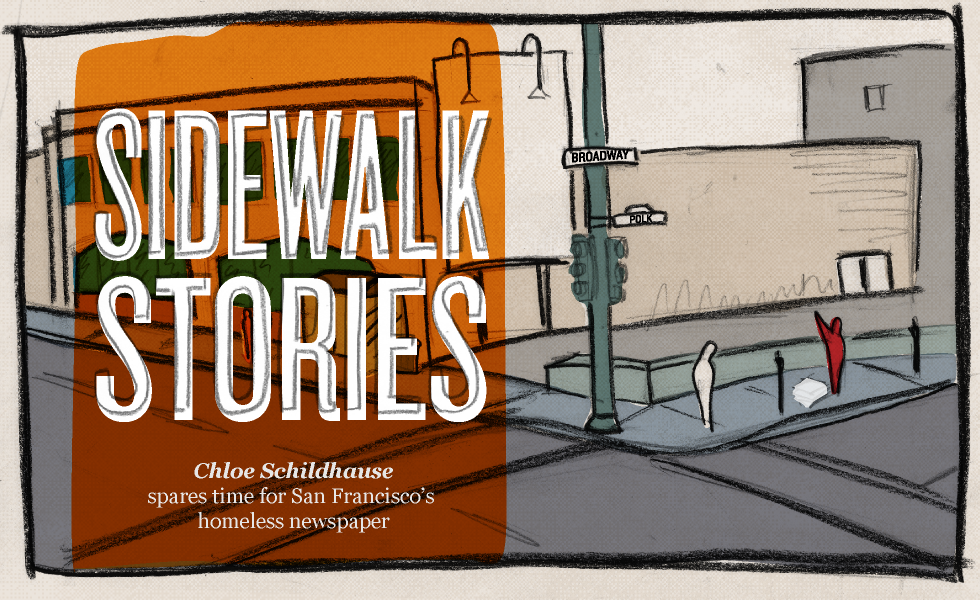
I always see Jasper Hammond when I walk down Polk Street. Usually, he’ll smile at me and say, “Good to see you, Chloe. How’s your father?”Jasper, a 63-year-old man with a charming grin and a rough gray beard, can be found most days outside Walgreens near Broadway asking for donations in exchange for Street Sheet.
I usually give Jasper money, but tell him he can keep the paper. One day I realized that I was rejecting a relatively cheap news source and decided to take the Street Sheet. There were good articles in that issue about access to homeless shelters and personal stories from people living on the streets. I became curious about the backstory on how the newspaper is put together.
I know that Street Sheet is created by the Coalition on Homelessness and is distributed by the homeless, or those living in low-income housing, as a way for them to earn money. Jasper says most people make donations, and few actually take the Street Sheet. But perhaps more would be inclined to read it if they knew the amount of work that goes into producing the paper, and about how it helps struggling San Franciscans on many different levels.

I attend the Street Sheet editorial meeting on a Thursday at the Coalition offices in the Tenderloin. After being buzzed in through the front door, I make my way up a stairwell where the carpeting has been torn apart. In a fluorescent-lit room full of simple wooden desks, I’m greeted by a man with a stringy beard named Karl Start, a Coalition volunteer who seems suspicious of my presence even after I tell him I’m doing a story about the publication.
Prior to arriving, I’d talked to Street Sheet editor Bob Offer-Westort about the history of the publication. It was created in San Francisco in 1989 at a time when massive cuts to public housing were occurring in the city. Bob says the publication has made a difference by calling attention to some of the more detrimental ways local government addresses homelessness, and it also helps people get jobs by giving them selling experience.
While I wait for the meeting to start, Karl tells me that other cities have their own versions of Street Sheet, but they call them something different. In London, for example, it’s called The Big Issue.
Bob, a 29-year-old man with round John-Lennon-style glasses, is the only paid Street Sheet staff member. Despite his title as editor, the process of deciding content of the publication is a collective one among those who work or volunteer for the Coalition. The articles, which usually pertain to issues around homelessness, are written either by those who are homeless or those who are involved in poverty or housing activism.
He announces that the meeting will begin shortly, so we move to another room where Lorraine DeGuzman, the Coalition’s development coordinator, is sitting at the table with her laptop. Other people arrive and the meeting eventually includes executive director Jennifer Friedenbach, family and immigrants organizer Miguel Carrera, and advertising coordinator Jenise Standfield. Jennifer is the most vocal, asking everyone what story ideas they’ve set in place.
“We ought to cover the shooting from two days ago,” Bob suggests. “But instead of making it an investigative piece, we should talk to the man who was shot at and get his point of view.”
The others like this approach and they continue to brainstorm: a story on Chris Daly is a possibility, an article on local columnist C.W. Nevius is pitched as Bob winces, and the merits of the Chronicle’s editorial board are discussed. People pass in and out of the room throughout the meeting and one volunteer starts nuking something in the microwave. The room begins to smell of dog food.
“So … any other story ideas?” Jennifer asks, pressing her fingers to the bridge of her nose in concentration. My mind starts to wander during the silence. I’m not the only one who is distracted. Miguel has wandered off, looking through documents in the corner of the room.
Jennifer calls him back to the table so they can get through the rest of the meeting. She tells everyone she has five more minutes before she has to go, and that she has to come back tomorrow to meet with a guy who calls himself Jesus Christ.


Once the content has been assigned and compiled, Street Sheet is then printed by Marin Sun Printing in San Rafael. The money for printing comes from private donors, either individuals or small foundations. Stacks of Street Sheet are made available for volunteers to pick up daily, but before someone becomes a vendor, they must attend a mandatory orientation.
Bob says you don’t have to be homeless to sell Street Sheet. The Coalition takes people on their word that they’re in need of the cash donations that come from the papers.
I attend a Friday orientation along with one other woman wanting to become a vendor, and a man named Stanley Michael Jackson who came by to pick up papers.
Orientation is simple. It consists of someone who works for the Coalition (today it’s Bennie Clyburn) reading off the rules. Vendors cannot say they’re selling Street Sheet, they can only ask for donations. The money they make throughout the day is theirs to keep. They cannot use alcohol or any illegal substances, get into fights, or sexually harass anyone while on the job, and they can pick up 75 issues each day, or 100 on Fridays before long weekends.
“I want to do this even when I’m not homeless,” the woman tells Bennie once he finishes the introduction. She explains that she needs enough money to go up to Seattle to visit her 19-year-old daughter. While she’s at the Coalition offices, she also gets advice from Stanley, who at age 58 has been selling Street Sheet for three years. They make plans to meet at the Embarcadero in the morning so he can show her the ropes.
“There will be hella people down there,” Stanley says with a lisp, the result of having lost a few of his top teeth. He then asks me for a donation and I pass him a dollar in exchange for the special poetry edition of Street Sheet.

While it’s impressive that Stanley has been selling Street Sheet for a few years, some vendors, like Jasper, have been on the job for over a decade.
I spend an afternoon with Jasper on Polk Street and admire his friendly approach. His slightly coarse voice projects across the street to the people eating outside Nick’s Crispy Tacos. He arrives to his outpost around noon every day and has been at this spot since 1993.
“Well, ponytail, I hate to see you go,” Jasper calls out to a woman who walks by without looking at him. He admits that he can’t help but mess with people and say “stupid things” sometimes.
Two women walk out of Walgreens, both wearing brown T-shirts. “Well, if it isn’t the brown sisters. How’s your day?” he asks. They walk by without responding. Being ignored is an accepted part of the job, but after 19 years of vending, Jasper has also accumulated many fans.
“Good afternoon, Jasper, how’s business today?” asks a man who eventually hands over a five-dollar bill. Later Jasper tells me that donations come slowly, and he has to be patient.
Jasper moved to San Francisco from San Antonio, Texas, in 1963 because his dad was in the air force. He currently lives in a hotel on 6th Street at Mission. “It’s better out here than at home,” he explains. “I have a violent woman.”
He says that on an average day he makes around $70, although one afternoon he netted $360. “A man by the name of Sheldon Franklin, who has adopted me in a way, once passed me an envelope with $260 in it,” Jasper said. “My daughter was very happy that day.”

I’ll admit that I’m guilty sometimes of ignoring the homeless. I think we all are. I’ve been in situations where I’ve seen someone holding up a sign asking for money and I’ll walk on by without glancing their way.
I can’t give a dollar to every down-on-his-luck person I encounter, but after spending time with so many Street Sheet volunteers, I’ve realized I can at least show respect every time our paths cross. Knowing the amount of work that goes into the paper, as well as Jasper’s level of commitment to selling it, I can’t walk by Street Sheet vendors without returning a smile and an occasional donation.

Your donations can help sustain Street Sheet and support the Coalition as a whole here. Or become a volunteer by attending its weekly staff meetings, which are open to the public and happen every Monday from 2 to 3:30 p.m. at the Coalition offices, 468 Turk Street.
Design: Ian Miller

The Bold Italic is a not-for-profit media organization, and we publish first-person perspectives about San Francisco and the Bay Area. We operate under a fiscal sponsorship of a 501(c)(3).
You can become a paid subscriber. Or donate. Or learn more about us.