



By Tony Bravo
It wasn’t any one incident that pushed me over the brink. It was the accumulation of a hundred incidents that were eating away at my psyche like chemical runoff seeping into groundwater.
I had to break up with Taylor.
I wasn’t sure how it got to this place, but I hadn’t been happy with our relationship for months. I’m told that’s what most couples say when
they separate, but here’s the thing: Taylor and I were never a couple.
We weren’t boyfriends, we were best friends, and knowing I had to cut
this tie filled me with a pain that severing most of my romantic
mismatches never had.
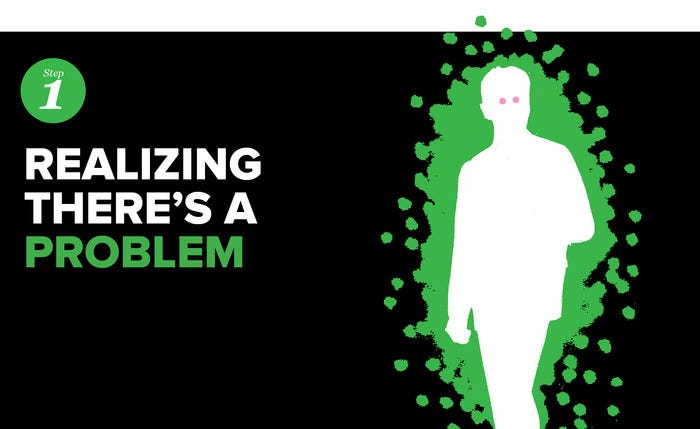
Taylor had become a toxic friend and was contaminating my life.
It didn’t start out that way. From ages 23 to 27 Taylor and I were inseparable. “TNT” (Tony ’N’ Taylor) was our joint moniker on the circuit. But for Taylor this had double meaning; he had an ability like no one
I’ve ever met to create a boom when you least expected it. That was
one of the things I liked about him initially, but as the years went by
the explosions were no longer of the firework variety; les feu d’artifice morphed into dirty bombs and more than once I’d been hit by shrapnel.
We outgrow friends for all kinds of reasons: priorities change, social circles shift — we’ve all been there. Then sometimes a realization hits like it did for me. You examine a friendship and acknowledge the things you already know. You’re tired of the toxic friend making messes and their reliance on you to clean them up, you’re tired of carrying their psychic weight, you’re tired of being a supporting player in your own life because the toxic friend is such a vacuum for your attention.
I was ready to call the emotional hazmat team.
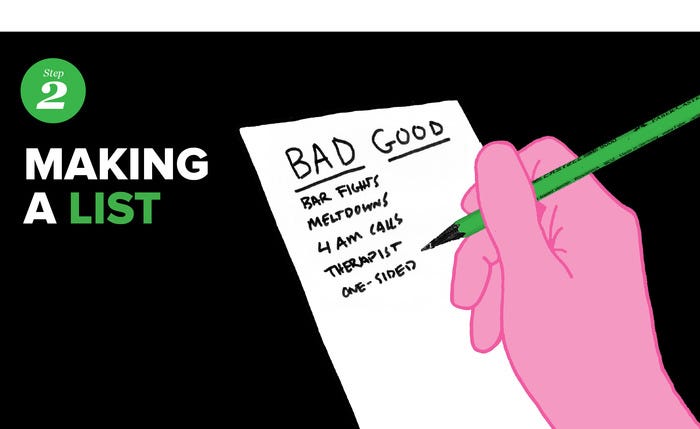
I sat down and made a list of all the good and bad things Taylor brought
into my life. It’s easy to make apologies for a person when the crimes
are undocumented. When you see the record it’s harder to ignore. On
the positive side, I wrote down parties we’d been to, people we’d met
together, fun we’d had, and secrets we’d shared. There was the
Fleet Week bar crawl where we convinced some sailors we were Mormon
missionaries who’d never tasted alcohol before. And the night we observed
a married movie star putting the moves on someone who was not his wife.
Then there was the Republican fundraiser we crashed, where Taylor
convincingly pledged a large sum of money to a conservative candidate
whose campaign team is likely still waiting for the check.
Then I made the other list. With each negative I committed to paper I
relived the traumas and was hurt anew. There was the first time I had to
pull Taylor out of a bar fight on Mardi Gras, followed in quick succession
by the times I had to pull him out of a bar fight on Saint Patrick’s Day, the
Fourth of July, and the second night of Hanukkah. I remembered all the
times I’d answered his hysterical 4 a.m. phone calls and slipped into the
role of on-call therapist. I recalled a thousand nights talking him through
terrible relationship choices only to watch as he turned around and reunited
with an abusive boyfriend and expected my support. I relived all the times
I’d felt obligated to make myself completely available for Taylor’s nuclear
emotional meltdowns, and I also relived the counter-moments where I needed
to confide my problems and he told me to “buck up” or “learn to deal with
disappointment” so I could immediately resume my role as his friend,
confessor, and analyst. There was an inherent inequality in our friendship
that was not going to change.
Seeing the unbalanced lists in front of me made my decision obvious,
but no less difficult.
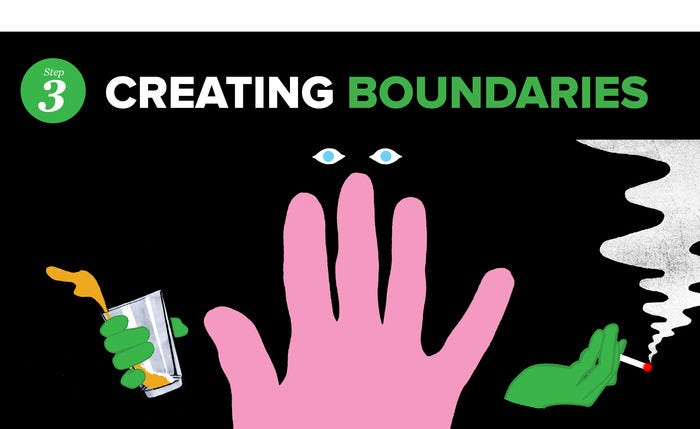
Past experiences with Taylor indicated that a final breakup conversation would not be productive. A conversation would lead to a scene, a scene would lead to threats, and threats with Taylor were usually carried out. I decided on the same course of treatment used for opiate addicts: carefully measured withdrawal.
I decided my disappearance would be less jarring if it were a gradual one. This wasn’t just for his benefit but also for mine. Small doses of Taylor would likely boil down our problems to their contaminated essence, and without a steady saturation of Taylor drama I’d lose my built-up immunity and be able to see our interactions clearly.
I stopped picking up his calls, and when I eventually returned them I was sure to keep conversations in the safe zone of casual gossip. I began turning down his invitations to go out, something previously unheard of in our relationship. But most importantly, I began turning my phone off when I went to bed. Any calls from Taylor that came in at 4 a.m. would now go directly to voicemail; the therapist was off the clock. I saw the breakup as creating a series of boundaries that had not previously existed. If they had been in place before this they could have possibly prevented the situation from evolving into the dependent ninth circle it had become. It was like a reverse East Berlin: Instead of tearing walls down I was
putting them up.
Once the boundaries were firmly in place it was time to complete my exit.
This stage was like pulling troops from an unwinnable war. Insurgent flare-ups
occurred but I needed to avoid another potentially fatal battle or engage in an
ultimately unproductive firefight.
I didn’t want to commit to leaving, but commit to staying away.
Taylor offered a hundred invitations to take him back. The temptations were
like backsliding with an abusive ex-lover, or saying “one drink at a party
doesn’t count” after completing rehab. Those invitations from Taylor kept
presenting themselves and for the first few months they were very tempting.
I missed our fun, our inside jokes, our secret language. I missed my friend.
When nostalgia reared its head I did a mental recount of the reasons I broke
things off, and when I compared the pain of having Taylor out of my life to the
pain of having Taylor in my life I knew I had made the correct decision. After a
few months of passive aggressive messages he seemed to move on and so
did I. There was no longer anything tempting about looking backwards.
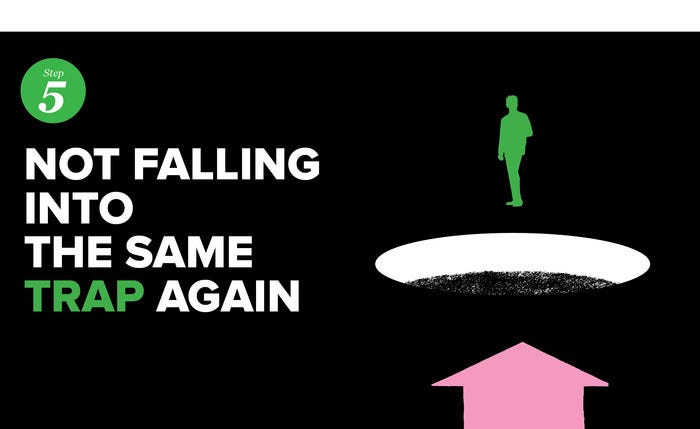
Enough time has passed that when I look back on Taylor now I can appreciate the fun we had without regret. But our friendship was like a beautiful apartment in a great neighborhood that happens to be full of asbestos and built on Indian burial ground. It seemed fine until I began to feel the woozy side effects. Now, when I run into him we seem to have achieved a casual civility and distance that is inherently safer than our friendship ever was. I’m grateful that I had Taylor as a partner-in-crime once upon a time and I’m grateful to have since moved on.
The thing I’m most grateful to Taylor for is overtly demonstrating so many of the warning signs of the toxic friend (the self-involvement, the outbursts, the neediness) that I can’t help but see when they’re revealed in new people. I’ve taken enough decontamination showers in the years since that I feel mostly free from any residual aftereffects from my exposure. I have also learned, hopefully once and for all, that the most effective method for avoiding contamination is to never get tangled with the toxic at all, no matter how fun the package.
The Bold Italic is a not-for-profit media organization, and we publish first-person perspectives about San Francisco and the Bay Area. We operate under a fiscal sponsorship of a 501(c)(3).
You can become a paid subscriber. Or donate. Or learn more about us.